

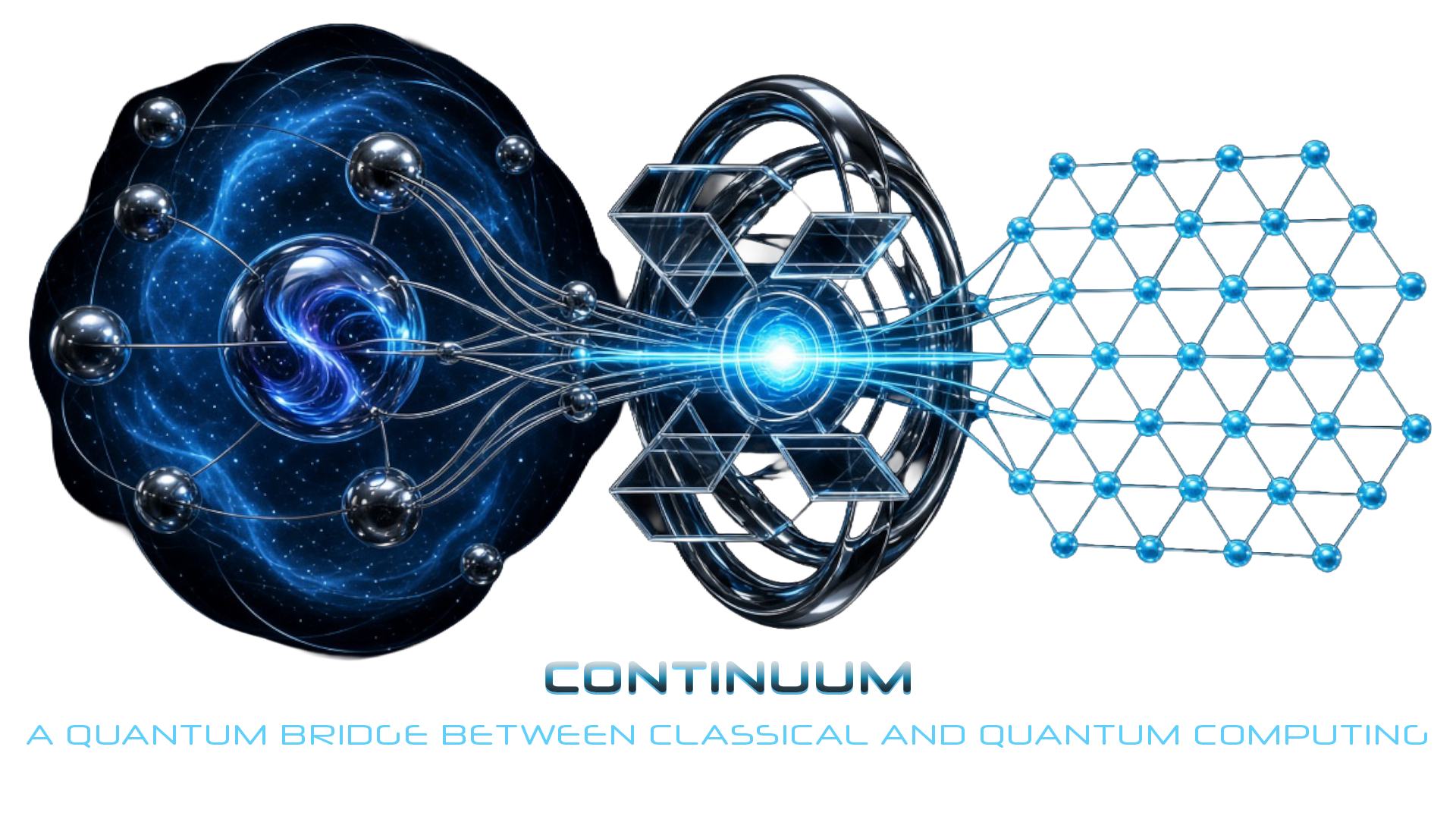
Quantum computing does not have to replace classical computing to make discovery more valuable.
A quantum processor adds a computational observation. Classical records, simulations and analyses contribute other evidence. Continuum brings eligible observations into a common scientific frame so an investigation can discover relationships across them. Quantum contributes where its measurements are useful; classical systems remain essential to preparation, reconstruction, comparison and application delivery. The customer gains a connected investigation without making every useful result depend on one processor.
Beyond qubit counts: a scientific observation you can investigate.
A qubit is a unit of quantum information. EcoSynQ’s qunit is a constructed scientific representation used in its geometry architecture. The distinction shifts attention from the size of an instrument to what its evidence supports. A qunit must remain bound to its construction, source and uncertainty; it is not a hardware qubit moved between machines. The commercial opportunity is the discovery application built around those inspectable scientific objects and their relationships.
The machine produces an observation. Continuum connects the investigation.
A returned number is the beginning of the evidence story. Its origin, method, uncertainty and scientific meaning determine how it can contribute. The Quantum Bridge connects construction, comparison, discovery and challenge so a useful relationship can be followed across datasets. Each new finding carries the evidence needed for the next question. These are connected responsibilities; an observation can be rejected or remain unresolved at any boundary.
FROM COMPUTATION TO CONNECTED DISCOVERY
Compute
Quantum and classical systems produce observations with identifiable sources and methods.
Computational choice →Represent
Symplecton, Tavnit and Netzer give eligible evidence geometric form under declared mappings.
Scientific geometry →Compare
Establish compatible meaning, time, uncertainty and source dependencies before an intersection has meaning.
Qualified comparison →Discover
Find a shared region, a persistent relationship, or a disagreement that opens the next question.
The 3D discovery lake →Challenge
Test the interpretation against alternatives and the evidence it actually depends on.
Independent challenge →Retain
Keep the result, supporting evidence, limits and corrections available for the next investigation.
Continuous Proof →
Provenance stays attached throughout. A failed comparison or unresolved challenge remains part of the record. Retaining evidence does not turn a candidate discovery into proven causation.
Keep the investigation as computing changes.
If quantum hardware improves, evaluate its new contribution against the existing baseline. If progress takes longer, continue the work that classical evidence and computing support. If providers excel at different tasks, qualify those contributions separately. Continuum’s architecture keeps the evidence requirements explicit while computational choices evolve. New resources still require adapters, justified mappings, policy review and workload validation. The durable asset is the connected investigation and its retained evidence, with each change measured against customer value.
Discover the questions your data has not taught you to ask.
There is more data than any team can examine. The deeper problem is not knowing which relationships matter, or even which question to ask. EcoSynQ connects quantum and classical observations through comparable geometry, exposes relationships across separate evidence streams, and turns those relationships into new paths of investigation. Discovery begins before someone knows what to search for.
Real data. Real discovery. A wider field of view.
EcoSynQ performs discovery with real quantum and classical data. Its work spans topographical mining data and underwater-drone investigations. The location-undisclosed gold-prospectivity case reports a selected result: 436 qualifying recurrences across 500 Rigetti QPU measurement runs. Follow-up findings reported by the exploration team include a coherent gold anomaly, supporting chemistry and repeat sample confirmation. Target coordinates, undisclosed project findings and proprietary transformations remain private. The public Data Lake combines retained quantum-derived records with illustrative classical connections so visitors can explore the mechanism.
One discovery opens the next.
A clue gains value when it opens paths beyond its original dataset. A terrain observation leads to a material question; a material relationship opens a supplier dependency; that dependency raises a new question for an industry or company. This illustrative path shows the compounding effect of discovery: each supported connection expands where the investigation can go. EcoSynQ brings those connections into a shared frame, accelerating exploration across datasets and disciplines while keeping the evidence behind each step visible.
You should not need your own quantum laboratory to discover.
EcoSynQ democratises discovery by connecting quantum and classical capability through Continuum, with Quantum Forge as the application and QaaS pathway. Businesses, researchers, and regional partners bring their domain knowledge and authorised data. The shared platform brings the computational capabilities, evidence relationships, and coordinated responsibilities. The starting point is the data you have and the problem you face, even when the right question has not emerged yet.
Quantum computing is already an experimental instrument.
Published work provides a concrete scientific foundation. In Physical Review B in 2020, researchers reported simulations of material dynamics on Rigetti Aspen and IBM Q16 Melbourne processors. A separate 2020 Physical Review Letters study ran circuits on IBM and Rigetti processors and distinguished topological edge states. These are experiments on quantum hardware investigating physical systems. EcoSynQ’s contribution is to connect quantum observations with classical evidence, discovery geometry, and an accessible application pathway.
What does the Quantum Bridge connect?
Businesses have records and observations that are difficult to compare across domains. The Quantum Bridge addresses that comparison problem through scientific geometry. Symplecton, built around a-qubit, constructs a geometric representation from quantum measurement evidence. Tavnit and Netzer transform classical evidence into representations whose comparability must be established in a common frame. Quantum Trellis exposes the resulting discovery neighbourhood. QORUM coordinates the participating systems, and Quantum Forge provides the application and QaaS pathway.
How does a discovery become an investigation?
In the Causal lake’s authored example, a reported 15% fall in lumber futures opens a path through materials, industries, and a homebuilding company. Quantum-derived geometry anchors a neighbourhood of classical clues. Compatible observations suggest a relationship to investigate. Purchase contracts, timing, alternative explanations, and source independence determine what the investigation can support. A futures movement alone cannot establish a company earnings outcome.
From public vision to an EcoSynQ implementation
EcoSynQ describes Continuum as the realization of the Quantum Bridge vision previously discussed publicly. The historical FOX Business interview is linked below in its original context. The listing identifies Sean Brehm with Spectral Capital at the time. The present implementation described here is attributed to EcoSynQ. This page does not treat the interview as independent validation of Continuum’s current capabilities.
What can you inspect today?
Explore the interactive Causal lake, the Continuum architecture, QORUM’s separation of responsibilities, and the Quantum Forge partner proposition. These public experiences explain the system and its boundaries. The lake combines retained quantum-derived records with authored classical connections; its animation is not a benchmark or proof of causal attribution. Private transformations and operational acquisition inventories are intentionally excluded from this public architecture account.